By Eng. Habibu A.S. · Updated
The ABCD pattern is a way to describe a price move, a retracement and a following leg using four chart points. This guide explains the MACX close-based interpretation: how to mark those points, what to watch at C and D, and how chart monitoring relates to the separate entry workflow.
The examples below include Synthetic Index charts. They illustrate the method within our Forex Strategies library; they do not represent Forex performance results.
- Map A, B and C from completed candle closes.
- Use C to start monitoring; a later qualifying close through B marks D.
- Keep chart monitoring separate from order execution.
- Review any MACX-opened position and make the final keep-or-close decision.
Software: MACX PRO EA 2.23 and MACX PATTERNS 1.63 · September 2026
1. How MACX uses the ABCD pattern
This article explains the ABCD candle structure the way MACX actually uses it. It is not a generic Fibonacci-harmonic textbook. MACX does not trade at point C. After a valid close-based A–B–C is found on M30 and/or H1, the system keeps monitoring C and D for possible opportunities. Any automatic basket still comes only from the separate MAIN pattern engine after M5 filters pass. ABCD itself never opens, closes, or reverses an order.
The live examples in this brief are the operator’s own charts: High Frequency Vol 50 Index on H1 and M30, plus a second completed map used to mark C as a watch and D as a later closed break of B.
2. What is the ABCD pattern in trading?
In standard market geometry, ABCD is a three-leg structure with four points.
- AB — the first impulse.
- BC — a retracement of AB that does not take out A.
- CD — a second impulse in the same direction as AB. Many textbooks place the reversal trade at D.
Those books usually require BC to retrace 61.8%–78.6% of AB and then project D so CD equals AB. MACX keeps the same four letters, but it does not trade C and it does not trade D. C starts a watch. D is a later opportunity or invalidation on a closed break of B.
3. How to identify A, B, C and D using candle closes
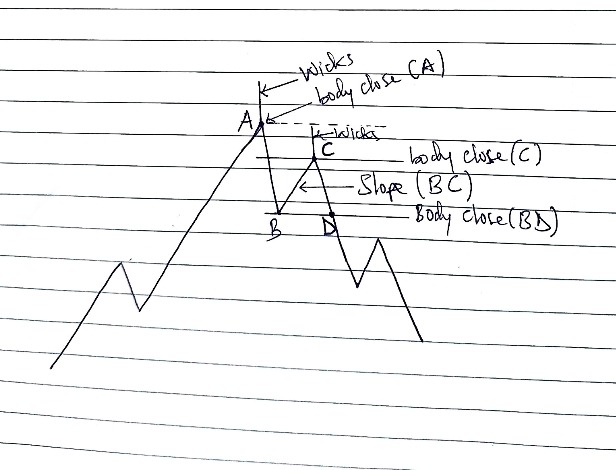
3.1 Body closes only — wicks are ignored
A, B, C and D are candle closes. The wick above A is not A. The wick at C is not C. A wick through B is not D. Only an opposite-direction candle that closes beyond the B close prints D. The BC slope is also close-to-close.
3.2 ABCD never blocks the MAIN signal
If an M30 MAIN BUY or SELL is accepted, the EA still parks that signal and waits for M5. Finding an ABC does not delay, cancel, hedge, or reverse that pending state, and it does not fire a trade at C. Missing an ABC also does not block the pending state.
3.3 C and D are monitored opportunities, not trades
When ABC is found on M30 and/or H1, MACX marks point C and starts the watch. It does not place an order at C. From that moment the structure stays live. The two later events that matter are whether price still respects the C zone, and whether an opposite-direction candle later closes through B (point D). Those events are possible opportunities or warnings. They never replace the MAIN-to-M5 execution path.
4. ABCD chart examples on H1 and M30
4.1 H1 — High Frequency Vol 50 Index
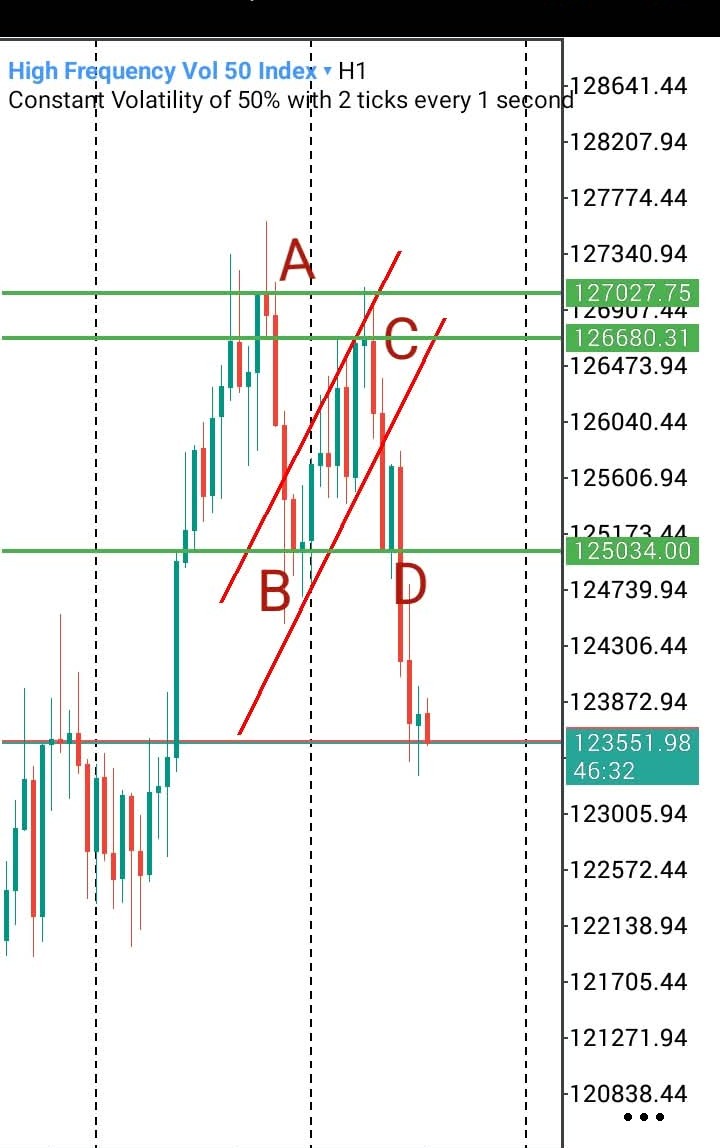
This H1 chart is the clean teaching example. Price rallies into A near 127,027.75. It drops to B near 125,034.00. It recovers to C near 126,680.31 without taking out the A close. Two red parallel rails hold the B–C channel. D is the later red candle that closes through the B shelf and continues lower. MACX would have started a C watch at the C close. It would not have sold there. The D close through B is the later monitored opportunity, not an automatic reverse.
4.2 M30 — same instrument, same map
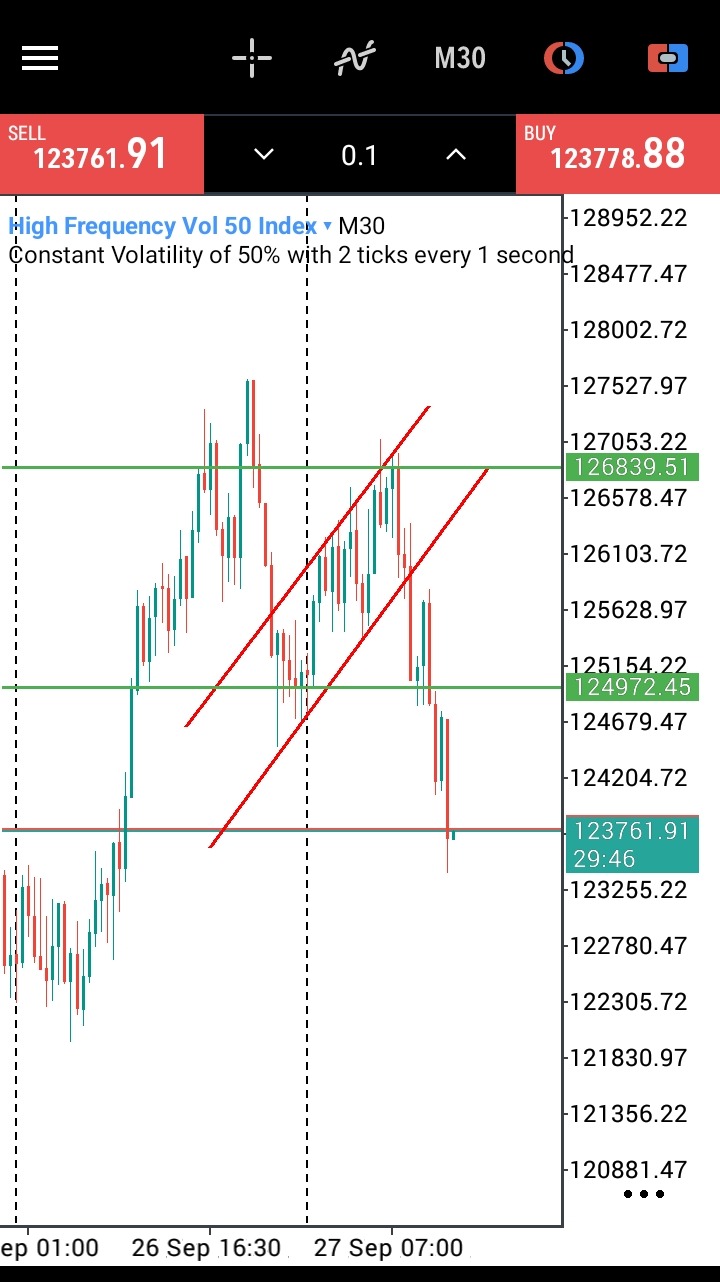
The M30 chart of the same index shows the identical channel without needing extra letters. The two red rails and the two green shelves are enough. MACX scans M30 and H1 independently. Either timeframe can start the C/D watch. Both timeframes printing the same map only improves context. It does not double the lot size and it does not create an extra order.
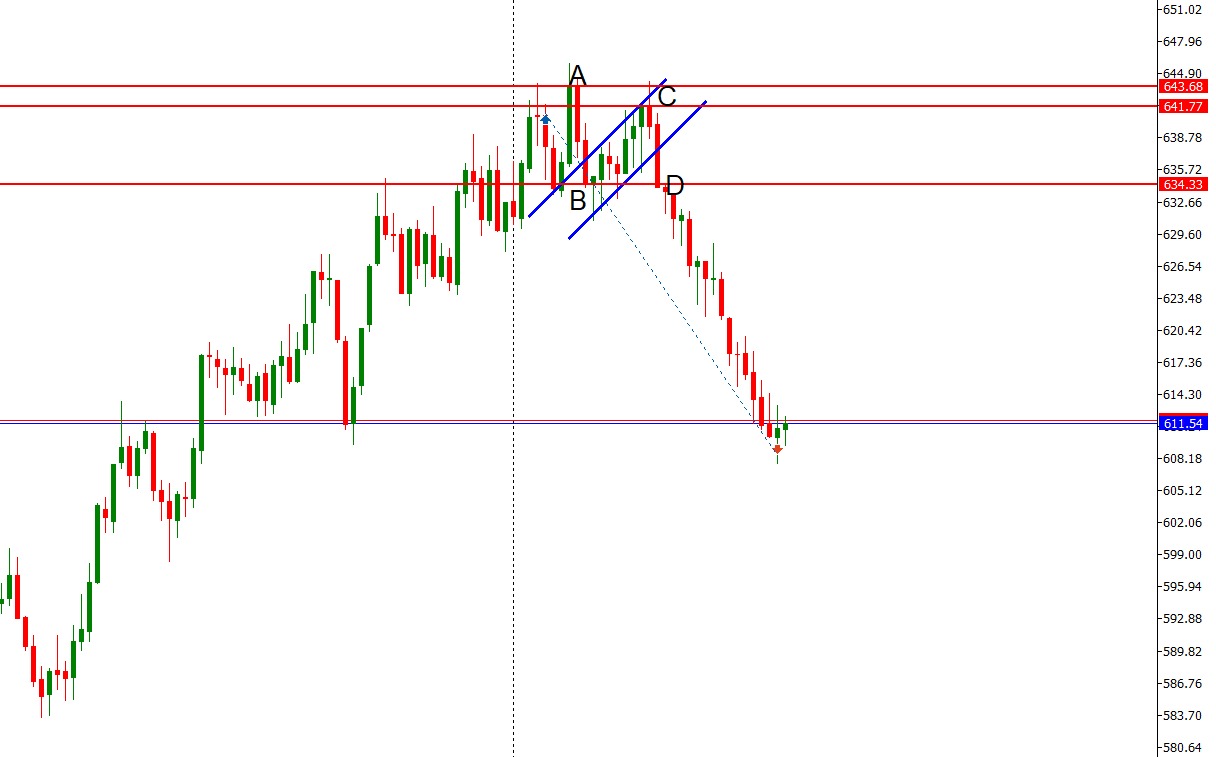
4.3 Second completed map — C is a watch, D is the B-break
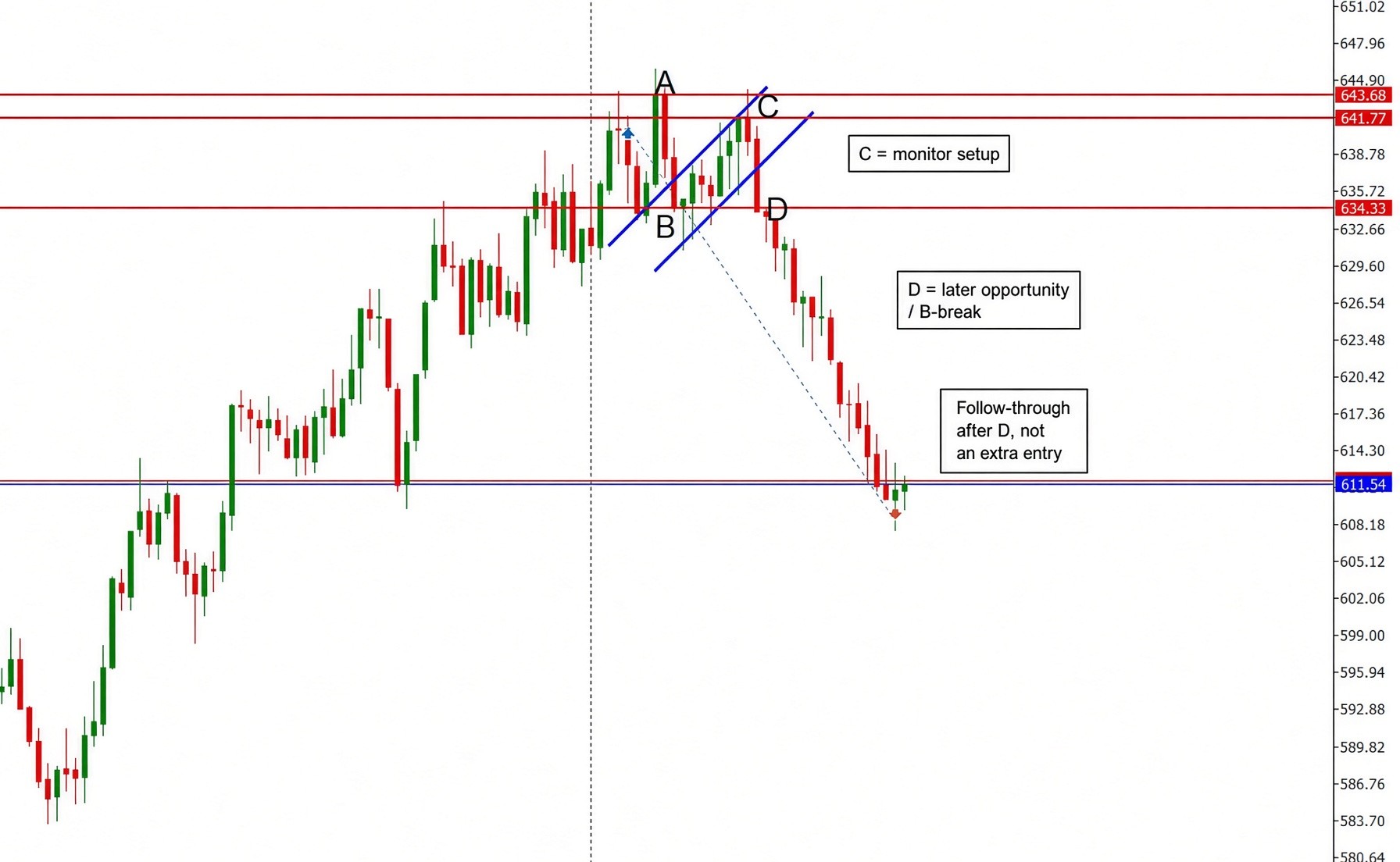
The next chart uses the same letters on a different symbol. A sits near 643.68, C near 641.77, B near 634.33. After C, MACX only watches. D is the later closed break of B. The move toward 611.54 is follow-through after D, not a second MACX entry.
5. MACX ABCD structure rules
| Rule | MACX value |
|---|---|
| Structure prices | Candle CLOSE only. Forming candles and wicks are never used. |
| Lookback | 30 closed bars on M30 and 30 closed bars on H1. |
| BC retrace of AB | Minimum 25%, maximum 95%. C must recover part of AB but must not close through A. |
| Minimum legs | At least one closed bar in AB and one closed bar in BC. |
| Timeframes scanned | Current M30 and H1. Either or both may be valid. H4 and D1 are not used for ABCD. |
| Parallel / CD ratios | Logged at D for diagnosis. They do not block the D notification and they do not open a trade. |
If those gates fail, MACX simply does not start the C/D watch. The MAIN pattern can still proceed to M5 confirmation as usual.
6. How the M30 setup connects to M5 confirmation
- M30 MAIN acceptedThe MAIN pattern owns the pending slot.
- Find close-based ABCSearch closed candles on M30 and H1.
- Start the C/D watchNotify at C. No order is opened at C.
- Keep M5 filters runningABCD does not block MAIN confirmation.
- MAIN may open a basketOnly after its M5 filters pass.
6.1 A MAIN M30 signal is accepted
ABCD is never scanned in isolation. The EA first accepts a current-chart M30 MAIN pattern and owns the pending MAIN slot.
6.2 Independent ABC search
Immediately after the slot is owned, FindAbcdPattern() runs on M30 and H1 using only candles that were fully closed at that decision time. One valid timeframe is enough to start the watch.
6.3 Mark C and keep watching
If either timeframe is valid, the EA stores A/B/C closes and times, draws the channel, and notifies that a C setup is now under watch. That message is not an order. MACX does not buy or sell at C.
Typical watch text: MACX SELL SYMBOL | ABCD SETUP at C — MONITORING C/D | TF M30+H1
6.4 The normal M5 pending flow continues
The MAIN signal stays pending until a newly closed M5 candle passes the filters — or until the parent H1 candle closes.
6.5 Only the MAIN-to-M5 engine may open a basket
When those M5 filters pass, the EA opens the basket. That fill belongs to the MAIN pattern engine. If M5 never confirms, the C/D monitor can still continue until D prints or A resolves the map.
6.6 After C — monitoring D and A
- Opposite closed candle through the B close: notify ABCD B-break at D. The watch resets. No order is opened or closed.
- Same-direction closed candle through the A close: that timeframe is resolved. If every active timeframe has broken A first, the watch ends quietly. No trade change.
7. Understanding ABCD watch and entry notifications
| Event | When it fires | What it means |
|---|---|---|
| ABCD setup at C | When ABC is found after a MAIN accept | Start monitoring C and D. Not a trade. |
| MAIN entry notice | Only after M5 filters pass and orders open | The only automatic trade. Independent of ABCD. |
| ABCD B-break at D | Later opposite CLOSED break of B | Later opportunity or invalidation. No automatic reverse. |
| A-break log only | Same-direction close through A | C/D watch for that timeframe ends. No trade action. |
The indicator on a separate terminal uses the same map and the same C-then-watch order. It does not share locks, baskets, or global variables with the EA.
8. What an ABCD watch does and does not do
- It does not trade at C. C only starts the C/D opportunity watch.
- It does not open, close, hedge, or scale a position at D.
- It does not park or delay the MAIN pending M30 signal.
- It does not use the separate higher-timeframe alerts. Those remain outside the ABCD monitor.
- It does not treat a wick through B as D.
- It does not replace stop-loss, basket target, or account-risk rules already in the EA.
9. How to review an ABCD chart step by step
Read C as the start of a watch. After C is mapped, observe whether price holds the C zone, fails back toward B, or later closes through B. Those later closes are the possible opportunities the monitor exists to show.
Read D the same way. A closed break of B is a later opportunity or a completed invalidation of the C map. It is not an automatic reverse. If a MAIN basket is already open from M5 confirmation, manage that basket with the EA’s PnL and session rules. If M5 never confirmed, you still had a C/D watch. That is intended.
When both M30 and H1 print ABC together, as in the Vol 50 examples, the watch is simply higher-quality context. Dual-timeframe structure does not double lot size and does not create an extra order at C or D.
10. Key takeaways from the MACX ABCD approach
MACX ABCD is a close-based monitor, not an entry module. After A–B–C is found, MACX does not trade at C. It keeps watching C and D for possible opportunities. The only automatic basket still comes from the MAIN M30 pattern after M5 filters pass. A later closed break of B is notified as D. A same-direction close through A ends the watch. Neither event places or closes an order.
Disclaimer
This document describes the behaviour of MACX PRO EA v2.23 and MACX PATTERNS v1.63. It is educational material for licensed operators. It is not an offer to trade, not a performance guarantee, and not a substitute for broker, regulatory, or personal risk review. Markets can invalidate any mapped structure after C. Position sizing and capital protection remain the operator’s responsibility.
Figures 1–5 are the operator’s own charts and sketch. © 2026 Eng. Habibu A.S. · MACX PRO · eng.habibu@gmail.com
ABCD pattern questions
What do A, B, C and D mean in a trading chart?
ABCD labels a price structure: AB is the first move, BC is a retracement and CD is the next leg. MACX uses candle closes to map the points; its D event is a later closed break of B.
Does MACX open a trade at point C or D?
No. C starts a watch, and D marks a later closed break of B. The ABCD monitor itself does not place or close orders. Automatic entries belong to the separate M30 to M5 workflow after its filters pass.
Which timeframes does MACX use for ABCD?
MACX searches closed candles on M30 and H1 for ABC structure. M30 means 30-minute candles, H1 means one-hour candles, and M5 means five-minute candles. M5 is used in the separate entry confirmation workflow.
Are these examples Forex trades or Synthetic Index charts?
The illustrated examples include High Frequency Vol 50 Index, a synthetic instrument. They explain the MACX chart-reading method and are not evidence of Forex performance or a recommendation to enter a trade.
Continue exploring MACX
- Browse the Forex Strategies library for educational chart guides.
- Explore MACX backtesting reports for historical results, charts and grading.
- See how MACX EA works, from an automated entry to your post-entry review.
- Read the MACX EA frequently asked questions for licensing and setup details.